Pre-order · macOS now, Windows to follow · delivery Q1 2027 Early access · available now for macOS · Windows to follow
Design the shape of your game
before you build it
Two desktop tools for the parts of design that live in a spreadsheet until they break. Map your campaign as a graph and see where the pacing sags. Turn your XP and damage formulas into curves you can actually look at.
Native macOS app · Windows coming · Plain-text project files · No account, no cloud
These apps aren’t finished yet. You’re pre-ordering: you pay today at the founding price, and the software is delivered when it’s ready — currently estimated Q1 2027. There is nothing to download right now. Full refund any time before delivery, for any reason.
Early access, available now. These are working apps, not finished ones — you get the macOS build the moment you buy, plus every update as they grow. The roadmap below is honest about what isn’t there yet. 30-day refund if it isn’t what you needed.
-
01
Throughline Progression
A node graph of every chapter, area and beat — and a timeline that reads one path through it and tells you where players will get bored.
How it works → -
02
Throughline Balance
Define stats as formulas or hand-placed points, tune the parameters on sliders, and watch the curves redraw while you drag.
How it works →
01 — Throughline Progression
Pacing problems are obvious on a timeline
and invisible in a doc
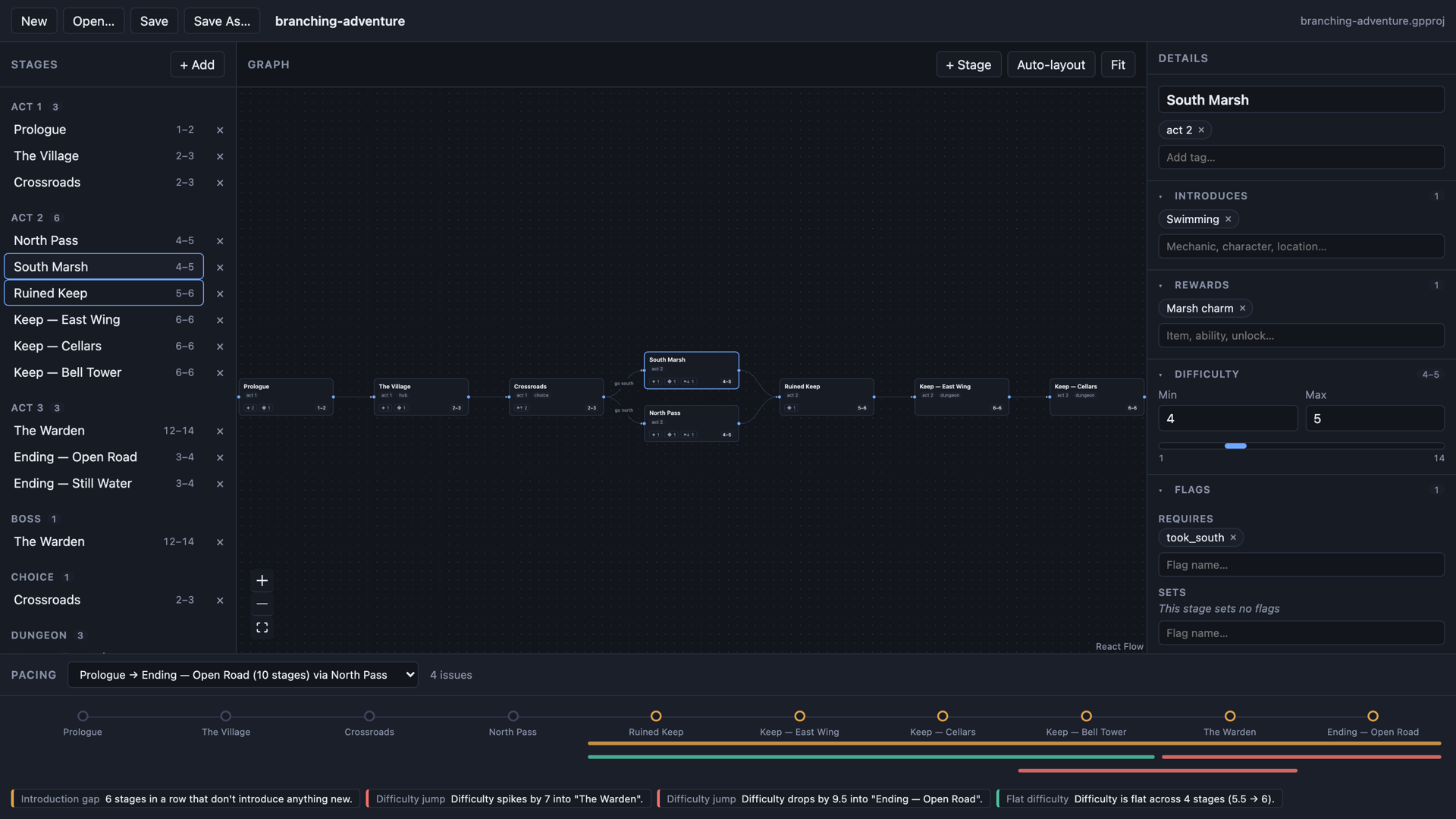
Every stage of your game is a node: a chapter, an area, a story beat. Wire them into a graph, tag what each one introduces and rewards, and the timeline reads a path through it and marks the stretches that sag.
-
A real branching graph
Not a list pretending to be a tree. Stages can have several predecessors and successors, and branches can re-converge — so a linear campaign, a visual novel and a non-linear adventure all fit without switching modes.
-
Pacing rules that fire
Five checks run over the path you pick: introduction gaps, reward gaps, difficulty that flatlines, difficulty that spikes, and flags required by a stage that nothing earlier ever sets.
-
Flag-gated routes
Mark which stages set a flag and which require one. The timeline traces whether a route is actually reachable, so a gate you wired backwards shows up before a playtester finds it.
-
Per-stage detail
Tags, what it introduces, what it rewards, a difficulty band, flags and freeform notes. Every field past the name is optional — most genres only use a slice of it.
-
Auto-layout, no cycles
Dagre lays the graph out so you're not dragging boxes into rows. Connections that would close a loop are refused as you drag them, because a cycle would quietly break pathfinding and pacing both.
-
Tunable thresholds
What counts as "too long without a reward" is one object at the top of one file. A roguelite and a 40-hour RPG do not want the same numbers.
Pre-orderGet Progression — $19 Will ship with a twelve-stage example project that has two deliberate pacing problems in it.
02 — Throughline Balance
Stop reading your XP table
and start looking at it
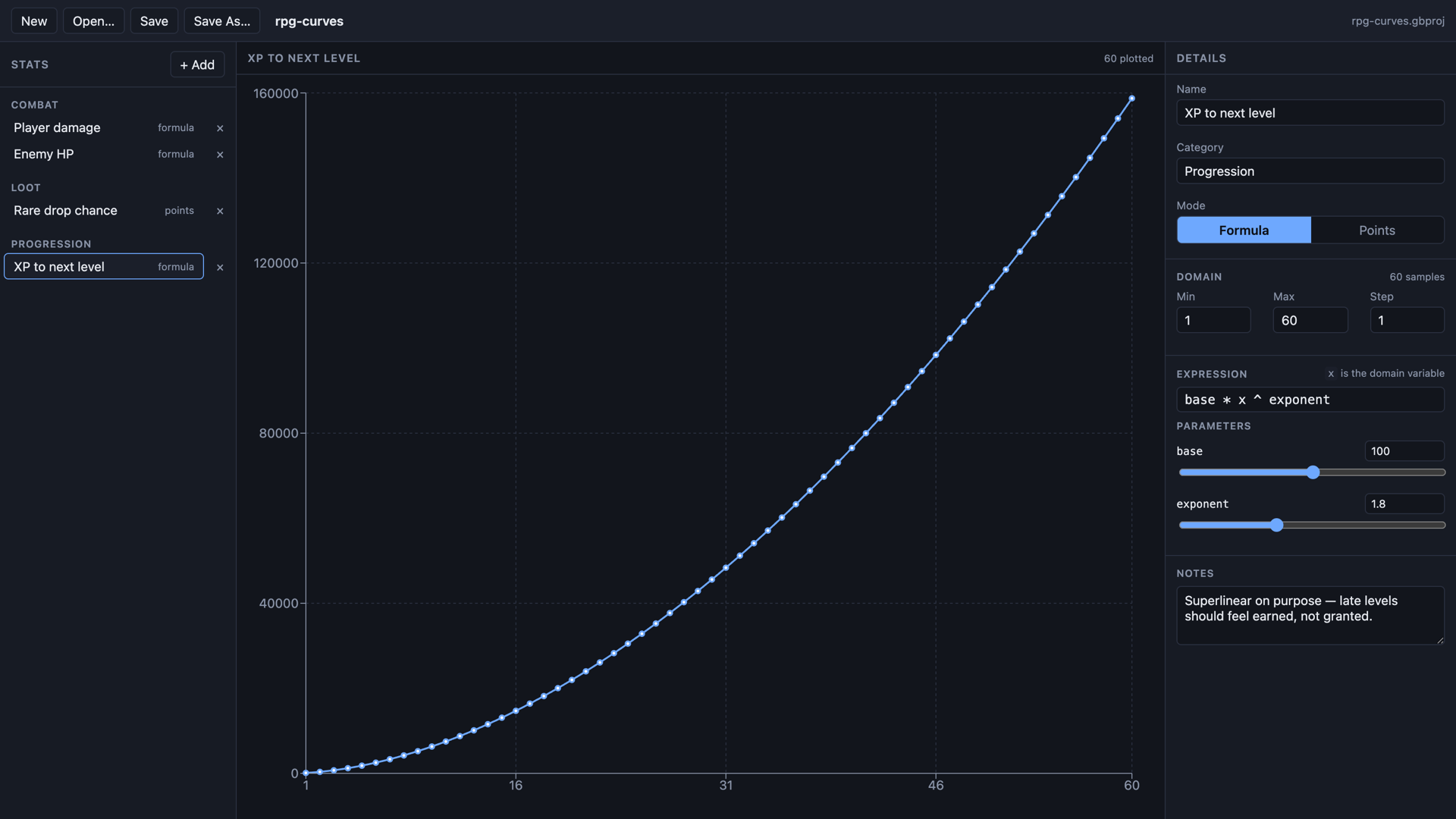
Damage curves, XP tables, drop rates. Write the formula, and the parameters inside it become sliders. Drag one and the curve redraws — including next to the other curves it has to stay in proportion with.
-
Formulas or points
Define a stat as an expression like
base + (x * scaling), or place the points by hand in a table. Switch between the two per stat, whichever way you actually think about that number. -
Parameters become sliders
Free variables in your expression are detected automatically and get a slider and a number field. No declaring them twice, no config step between writing and tuning.
-
Comparisons Planned
Name a set of stats and plot them together — player damage against enemy HP, XP required against XP granted. The relationships that matter are between curves, not inside one. The data model is in place; the view lands before release.
-
Explicit domains
Every stat declares the range it's defined over — levels 1 to 100 in steps of 1. Sampling is bounded, so a tiny step across a huge domain warns instead of hanging the window.
-
Expressions stay sandboxed
Project files get shared between designers, so a formula is only ever evaluated against
xand its own declared parameters — never an open scope. -
Validation before it bites
Bad expressions and impossible domains are caught and explained where you typed them, rather than rendering an empty chart and leaving you to guess.
Pre-orderGet Balance — $19 Uses the number-only math.js build — same expressions you'd write in a spreadsheet.
Both apps
Your design docs shouldn't need our servers
These are native desktop apps that open and save files on your disk. That's the whole distribution model, and it's deliberate.
-
Plain, diffable JSON
.gpprojand.gbprojare pretty-printed JSON meant to be read and hand-edited. Commit them next to your engine project and code review a pacing change like any other diff. -
No account, no cloud
Nothing to sign into, nothing phoning home, no seat that expires. The app runs offline on a plane and your unannounced game stays on your machine.
-
Saves that can't corrupt
Writes go to a temp file and get renamed into place, so a crash or a pulled cable mid-save can't leave you with half a project file.
Where these actually are
What you're actually buying
Nothing here is downloadable yet. Both apps are at v0.1 in active development, and you'd be backing them before release. Here's the honest state of the work, so you can judge whether the estimate is credible.
Built and working (not yet released) In this release
- Progression: graph editing, per-stage detail, auto-layout, all five pacing rules, open/save
- Balance: formula parsing and evaluation, points editing, parameter sliders, live curve preview, open/save
- Native macOS build (Apple Silicon and Intel), running locally
Still to do before delivery Not there yet
- Undo/redo
- Exporting curves and tables to CSV/JSON for your engine
- Balance: plotting a comparison set as multiple curves at once
- A Windows build — needs a Windows machine or CI, which isn't set up
- Code signing, so the apps open without a security warning
- Packaging and delivery — the part that turns this into something you can install
- Simulation in Balance, beyond static curves
Founding price, locked. You pay today's price once and keep every update through 1.0 and the whole 1.x line. Prices rise to $39 each and $59 for the bundle at release; yours doesn't. If the date slips you'll hear it from me before you read it anywhere else — and you can take a full refund at any point before delivery. If it isn't what you needed, the 30-day refund below is real.
Pricing
Buy either. Or both, for less.
One-time purchase, no subscription. Prices in USD, tax added at checkout where required.
The 1.0 release and every update across the 1.x line.
Everything in Standard, plus updates for life — including future major versions — and a direct contribution to getting these built.
Throughline Progression
$19
Goes to $39 at 1.0
- Branching stage graph
- Pacing timeline & five rules
- Example project included
- Every update through 1.x
$49
- Branching stage graph
- Pacing timeline & five rules
- Example project included
- Updates for life, including future major versions
- Directly funds the work
Best value
Both apps
$19
Goes to $59 at 1.0
- Everything in both apps
- Plan the flow, then tune the numbers
- A licence key for each app
- Every update through 1.x
$49
- Everything in both apps
- Plan the flow, then tune the numbers
- A licence key for each app
- Updates for life, including future major versions
- Directly funds the work
Throughline Balance
$19
Goes to $39 at 1.0
- Formula & points curves
- Parameter sliders, live preview
- Multi-stat comparisons
- Every update through 1.x
$49
- Formula & points curves
- Parameter sliders, live preview
- Multi-stat comparisons
- Updates for life, including future major versions
- Directly funds the work
Refund any time before delivery, plus 30 days after. Reply to your receipt and you get your money back — no form, no interrogation. You're paying ahead of the work, so the exit stays open the entire time you're waiting.
30-day refund. Reply to your receipt and you get your money back — no form, no interrogation. Buying unfinished software shouldn't be a gamble.
FAQ
Questions worth answering
When do I actually get the software?
Currently estimated Q1 2027. That's an estimate from a solo developer, not a contract — if it moves, you'll get an email explaining why, and you can take a full refund on the spot. I'd rather tell you late than quietly miss it.
What do I get right now, today?
An email with your licence key and a download link for the macOS build, within a minute of buying. It's a universal build, so it runs on Apple Silicon and Intel. Windows isn't ready — see below — and your licence covers it free whenever it is.
What do I get right now, today?
An emailed order confirmation with your licence key and your locked founding price. No download — there isn't one yet. When the builds are ready, the download link goes to the same email address.
What if you never ship it?
You get your money back. That's the whole answer. There's no deadline on the before-delivery refund, so the risk of the project stalling sits with me, not you. Your card issuer also gives you a dispute route, though I'd much rather you just emailed me.
Do I need both apps?
No — they're separate tools and either stands alone. They're built to sit either side of the same job: Progression is where you decide the shape of the game, Balance is where you decide the numbers inside it. The bundle exists because most people eventually want both, not because one needs the other.
What platforms?
macOS today — a native app built on Tauri, universal so it runs on both Apple Silicon and Intel.
Windows is coming but is not here yet. Tauri can't build a Windows installer from a Mac, so it needs a Windows machine or a CI runner, and that isn't set up. I'd rather say that plainly than list Windows and leave you guessing. If you're on Windows, your licence covers it the moment it ships at no extra cost — but buy with your eyes open, and the refund stays available the whole time.
No web version, and no Linux build yet — if you need Linux, say so and it moves up the list.
What will I see on first launch?
Right now the builds aren't code-signed, so macOS Gatekeeper will warn you and you'll need to right-click → Open the first time. Signing is on the list above and this answer will change; until it does, it's better that you hear it here than at the download.
Can I use these on a commercial game?
Yes, with no revenue cap and no royalty. Buy once per person who uses it. There's no licence check phoning home — the key is how you get updates and support, not a lock.
What happens to my files if I stop paying, or you stop shipping?
Nothing. There is no subscription to stop paying, the apps keep working offline forever, and your projects are plain JSON you can read in any text editor. If this project ends tomorrow your design docs are still yours and still legible.
Is there a trial?
Not yet. The 30-day refund is the trial — buy it, use it properly on a real project, and ask for your money back if it doesn't earn its place.
Team or studio licences?
Get in touch and we'll sort out a site licence and one invoice rather than making you buy seats one at a time.
Find the sag before your players do
Pre-order at the founding price. Delivery estimated Q1 2027, refundable in full at any point before then.
Available now for macOS, at the early-access price. 30-day refund, and every update through 1.x included.
See pricing